Tiller Resource Center > Spreadsheet Financial Systems > Net Worth & Cash Flow Spreadsheets
Most financial tools are backward-looking. They show you what you spent last month, what your balance was on Tuesday, where your money went. That’s certainly useful. But the questions that reduce financial stress tend to be forward-looking: Will I be okay in three months? Can I afford this renovation in the spring? What happens to my finances if I take that lower-paying job?
Cash flow planning helps you answer those questions before they become problems.
What cash flow planning is (and why it’s different from budgeting)
Budgeting looks at categories: how much you’ll spend on groceries, dining, utilities, and entertainment each month. It’s organized around what you spend.
Cash flow planning looks at timing and totals: will you have enough money, and when? It’s organized around when money moves — income coming in, expenses going out, and the running balance between them.
A cash flow plan projects forward — next week, next month, next quarter — based on expected income and committed expenses. It answers questions that a budget can’t, such as:
- If I put a down payment on a car in February, what does my financial picture look like in April?
- I’m self-employed and my income drops every summer — when should I start reducing discretionary spending?
- I want to book a vacation in October — what does my balance trajectory look like between now and then?
Cash flow planning is especially useful when you’re navigating a major expense, a job transition, seasonal income swings, or saving toward a goal with a specific deadline.
Building a basic cash flow projection
A cash flow projection is a timeline — rows for future periods, columns for income, expenses, and balance.
The structure:
| Period | Starting Balance | Income | Committed Expenses | Variable Expenses | Ending Balance |
| Jan | $4,200 | $5,000 | $3,100 | $800 | $5,300 |
| Feb | $5,300 | $5,000 | $3,100 | $800 | $6,400 |
| March | $6,400 | $5,000 | $4,100* | $800 | $6,500 |
*March includes the quarterly insurance premium.
The ending balance for each period becomes the starting balance for the next. The running balance formula is:
=Starting Balance + Income – Committed Expenses – Variable Expenses
To build this in Google Sheets:
1. Start with your current account balance as the beginning balance for Period 1
2. Add known income — pay dates, expected client payments, regular transfers
3. Subtract committed expenses — rent, mortgage, insurance, loan payments, subscriptions (anything with a fixed due date)
4. Estimate variable expenses — groceries, dining, gas, entertainment — based on recent monthly averages
5. Carry the ending balance forward as the next period’s starting balance
The result is a projection you can read like a financial weather forecast. You’ll be able to see — months in advance — which periods look comfortable and which look tight.
Planning for big expenses and financial goals
One of the most practical uses of a cash flow projection is modeling a large upcoming expense before you commit to it.
How to model a big expense: Insert the amount into the projection at the expected payment date and see how it affects your balance trajectory. If you’re planning to spend $4,000 on a home repair in June, add it to June’s expenses. Then look at the balance for July and August. Does it recover reasonably? Does it stay above a level you’re comfortable with? The answer tells you whether June is actually the right time, or whether you should push it to September.
Saving toward a goal: Work backward from your target. If you want to have $6,000 saved by November for a holiday purchase, figure out how much needs to come out of each month’s ending balance between now and then. Your projection shows whether that’s realistic at your current income and expense levels, or if you need to save more some months than others.
Scenario planning: Create two versions of your projection — a base case and an alternative. You can easily create two forecasts:
- “What if I get the raise in Q2?” vs. “What if the raise doesn’t come through?”
- “What if we do the renovation this year?” vs. “What if we wait until next spring?”
Side-by-side scenarios let you compare outcomes without committing to either path. You’re doing the thinking in a spreadsheet before spending real money.
Making your plan more accurate over time
A cash flow projection is only as good as its inputs. The first time you build one, your variable expense estimates are educated guesses. Over time, they get better.
Compare projections to actuals each month. After the month ends, look at what you projected vs. what actually happened. Were your grocery estimates close? Did your dining out come in higher? Adjust your estimates for future months based on what you learn.
Track income accuracy for variable earners. If you’re a freelancer or commission earner, note how your conservative income estimates compared to actual receipts. Were they too conservative? Not conservative enough? The goal isn’t to be pessimistic — it’s to be accurate.
Look at seasonal patterns. Utilities spike in winter and summer. Entertainment spending often rises in summer and December. Healthcare costs can cluster in Q1 if you’re working toward deductibles. After 12 months of data, these patterns become visible and your projections become significantly more accurate.
The longer you maintain a cash flow plan, the more useful it becomes. Your estimates stop being guesses and start being informed predictions.
Connecting real data to your cash flow plan
A cash flow projection is forward-looking, but it needs an accurate starting point — your current balance and recent spending patterns.
Manual approach: Update your projection with actual balances and recent spending data once a week or month. This works, but it’s only as current as your last update.
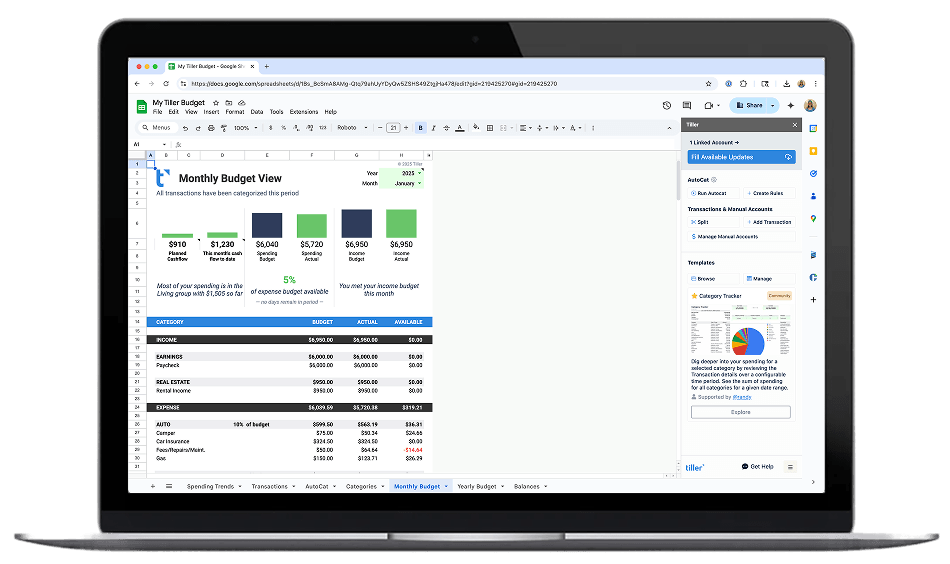
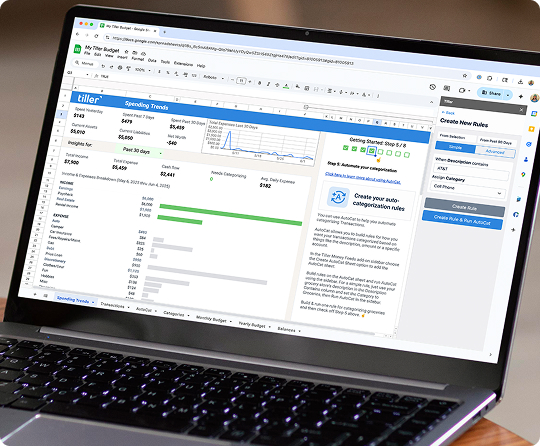
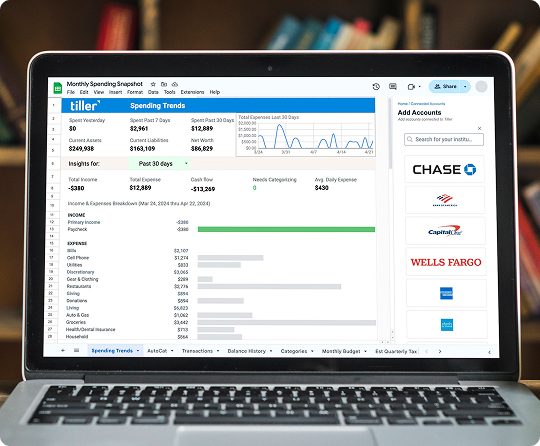
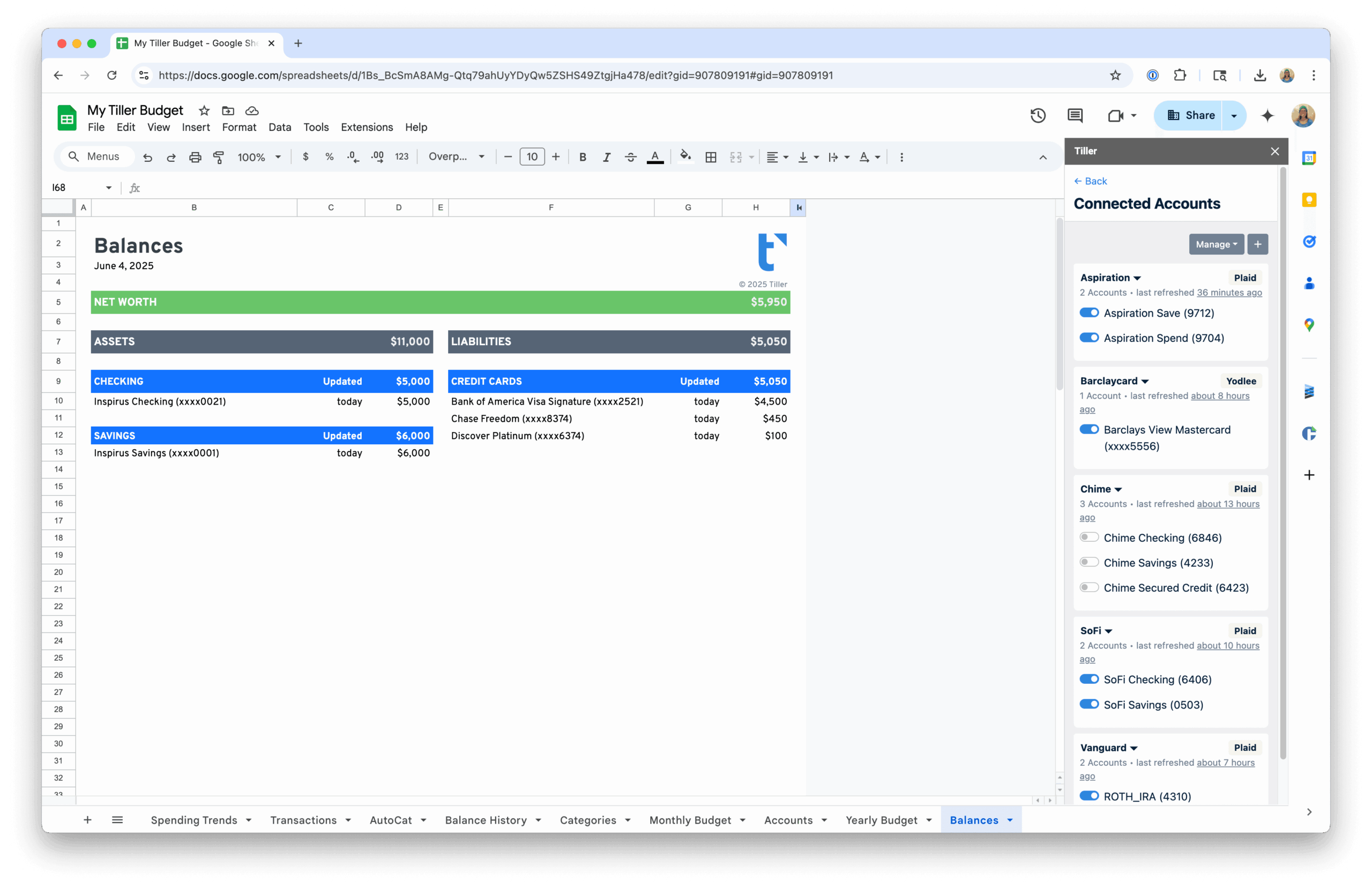
With Tiller: Your actual transaction data and account balances update daily in your spreadsheet, so you always know your real starting balance. You can also use Tiller’s transaction history to calculate accurate variable expense averages — what you actually spend on groceries, dining, and discretionary purchases — rather than estimating from memory.
The most effective setup combines automated actuals (Tiller keeps your current balance and spending history accurate) with manual projections (you enter expected future income and committed expenses). The actuals ground the starting point in reality, and the projections extend that forward into a usable forecast.
Frequently asked questions
What should a cash flow plan include?
A personal cash flow plan should include your current account balance (the starting point), expected income with dates (paychecks, client payments, transfers), committed expenses with due dates (rent, loan payments, insurance, subscriptions), estimates for variable expenses (groceries, dining, discretionary), and a running balance that shows your projected balance after each period. The running balance is the key output — it tells you whether you’ll have enough money when you need it.
How do I project my cash flow for the next three months?
Set up a spreadsheet with one row per month. Enter your current balance as the starting balance for Month 1. For each month: add expected income, subtract committed expenses, subtract estimated variable spending. The result is your ending balance, which becomes Month 2’s starting balance. Repeat for three months. This gives you a rough trajectory that shows whether your balance is growing, stable, or declining over the period.
How is cash flow planning different from budgeting?
Budgeting organizes spending by category — it tracks what you spend. Cash flow planning organizes money by time — it tracks when money moves in and out and whether your balance stays positive throughout. You need both. Budgeting helps you manage spending behavior, and cash flow planning lets you manage timing and ensure you have enough money on the right days.
How do I handle irregular income in a cash flow projection?
Use conservative estimates for income timing. For months where income is uncertain, use your minimum expected amount rather than your average. When larger payments arrive, update your projection with the actual number and see how it changes the forward balance. Over time, tracking your income projections against actuals helps you calibrate your estimates so they become more useful.