Why I’ve Started 47 Budgets (And the One That Finally Stuck)

I’ve started a budget approximately 47 times.
Roughly. Conservative estimate.
I’ve used apps that pinged me when I spent too much on coffee. I’ve tried the envelope method, on paper, with actual envelopes. I’ve built spreadsheets from scratch and abandoned them by week three. I made a beautiful Notion budget, which I opened exactly twice.
I’m Jamie, and I work at Tiller, which is a budgeting tool.
Yes, I know that makes my track record slightly confusing.
But it also means I can tell you, with full credibility, why most budgets fail and why this one didn’t.
Why budgets fail (it’s not what you think)
Conventional wisdom holds that people fail at budgeting because of a lack of discipline. They overspend. They don’t track. They buy too many treats.
I think that’s mostly wrong. People fail at budgeting for two reasons.
The system has too much friction. Every budget I tried required me to do something I didn’t want to do: log into six bank accounts, manually enter purchases, and look at numbers I was emotionally avoiding. That friction compounds. By week three, even the most motivated budgeter is quietly opting out.
The system doesn’t fit how you actually live. Most budgeting tools come with someone else’s idea of how to organize your money. Categories you didn’t pick. Rules you didn’t write. Aesthetics designed for someone who isn’t you. When the tool doesn’t align with how your brain works, you stop using it.
The 47 budgets I quit all had one of these problems. Usually both.
What changed
The budget that stuck wasn’t fancy. It wasn’t an app. It wasn’t gamified or color-coded by a UX designer in San Francisco.
It was a spreadsheet.
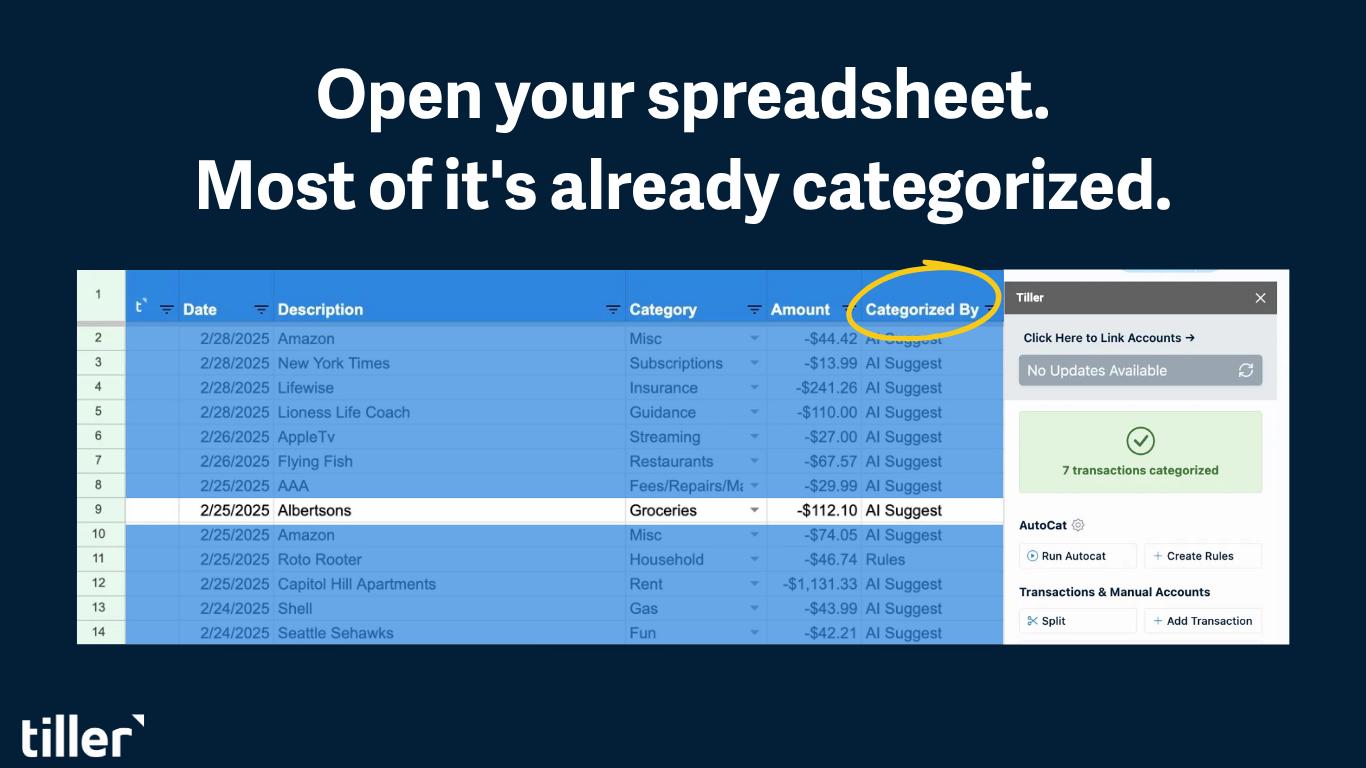
Specifically, it was a spreadsheet that filled itself in. Magic!
That’s the part that mattered. Not the spreadsheet — the automation behind it. The friction that killed my other 47 budgets disappeared the moment I stopped having to manually enter anything. My bank and credit card transactions just showed up. I categorized them, or I let AutoCat do it for me. That was it.
And because it was a spreadsheet — not an app, not a locked dashboard — I could shape it around how I think about money. Not how a product designer thinks about money. Mine.
How Tiller actually works (briefly)
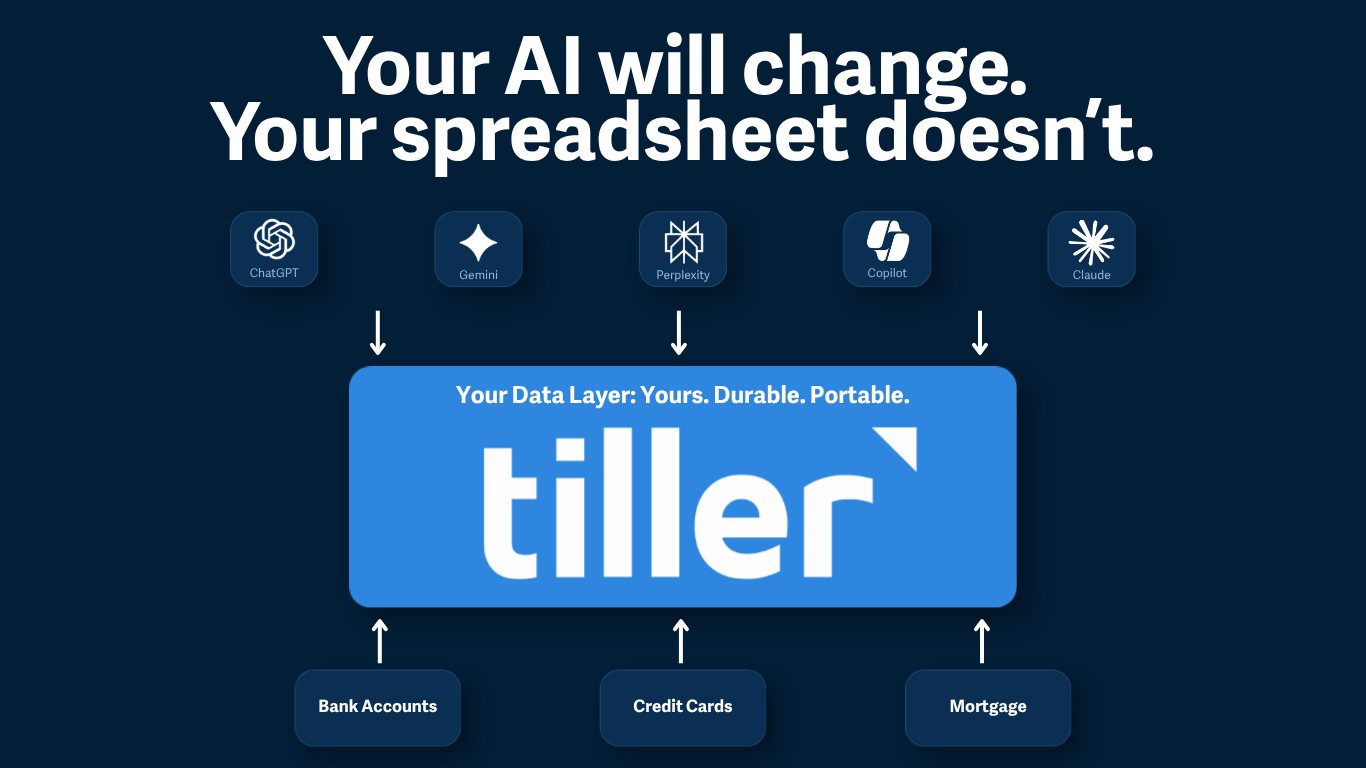
The version of this you’d hear from someone in marketing goes like this: Tiller connects to your bank and credit card accounts and automatically imports your transactions into a Google Sheet or Excel workbook every day.
You can categorize transactions manually or set up rules that categorize them automatically. You can use Tiller’s templates — a budget, a debt tracker, a net worth dashboard — or build your own. Or both. Or neither. The spreadsheet is yours.
That’s genuinely it.
No ads. No notifications. No one is selling your data to whoever buys data these days. Just your money, laid out in a place you actually control.
What it’s like, two years in
I still don’t love budgeting. I’m not going to lie and say it became fun. But I do it now, consistently, because the part I hated — the part that killed every other system I tried — no longer exists.
I open my spreadsheet on Sunday mornings. The transactions from the week are already there. I scan them, fix any miscategorized ones, and look at where the month is going. The whole thing takes maybe ten minutes. I can’t even finish my whole coffee in that time.
Some weeks, I notice I’ve spent more on takeout than I intended. I used to interpret that as a failure. Now I interpret it as information. The budget tells me what happened. What I do with that information is up to me.
That’s the difference between a budget that lasts and a budget you quit. The lasting one doesn’t punish you. It just shows you what’s true.
If you want to try it
You can try Tiller free for 30 days. If you keep going, it’s $99/year: about $8.25 a month, which you can absolutely include in your budget.
If you want to start with something smaller, the Foundation Template is the spreadsheet I use. It’s free to look at and walks through the basics of how the system works.
And if you’re somewhere earlier in the process — still figuring out whether you can even bring yourself to look at the numbers — that’s the next post. I’ll meet you there.