

Let me tell you something nobody really talks about.
Budgeting is hard.
But not in the way you think.
It’s not hard because of the math. It’s not hard because of the apps. The apps are (mostly) fine.
It’s not hard because budgets are restrictive. In fact, most of the budgets that work are not particularly restrictive.
Budgeting is hard because of the part you won’t find in the marketing copy: At some point, you have to look at the numbers. Like, really look at them. With your eyes open. Without flinching.
That’s it, that’s the whole thing. And once you’ve done it once, the rest gets a lot easier.
Why we avoid the numbers
I avoided my own finances for years. Not because I was bad with money, but because looking felt like an admission. Like the moment I opened the spreadsheet, I’d have to confront whatever I’d been telling myself was fine.
What if I’d spent more on takeout than I thought? What if my subscriptions added up to something embarrassing? What if I was living above my means in a way I hadn’t quite let myself see?
So I didn’t look. I made vague resolutions.
The avoidance wasn’t laziness. It was a small, private kind of fear. And I think a lot of people are quietly carrying the same one.
The reframe that changed it for me
Here’s what I wish someone had told me earlier:
A budget is not a punishment. It’s a tool.
Going over your budget isn’t a failure. It’s information.
A budget is not a list of things you’re not allowed to do. It’s a description of what you want your money to do and a way to find out whether it’s actually doing that. If it isn’t, the budget isn’t accusing you of anything. It’s just showing you.
The first time I spent more on restaurants than I’d budgeted, I felt like I’d failed. Turns out, it’s really easy to overspend on something when you have no idea what you’re spending. The second time it happened, I started to notice a pattern: Weekends, mostly, and almost always when I was “catching up” with someone I hadn’t seen in a long time. That wasn’t a moral failure. That was an imagination problem. How else could I check in with my friends and family? What creative, lower-cost activities could we do together? When was it actually worth trying that new restaurant, and when was I leaning on the easy option? When I started being more intentional about my time (and money!), restaurant spending dropped, not because I disciplined myself, but because I’d seen the actual shape of what was happening.
That’s what the numbers are for. Not to indict you. To tell you what’s true.
How to take the first step
If you’ve been avoiding looking at your finances, you already know that the avoidance is the hardest part. So here’s what I’d suggest, and this is the same thing I’d say if we were having coffee:
Start with one week. Not a year. Not a month. One week. Pull up your bank account and your credit card statements and review every transaction. That’s it. No categorizing. No spreadsheet. Just look.
Don’t judge what you see. You’re collecting information, not building a case against yourself. If something surprises you, write it down somewhere. Don’t try to fix anything yet.
Notice patterns, not items. A single $14 lunch doesn’t mean anything. Twelve of them in a week means something. The pattern is the data. The individual transaction is noise.
Do it again next week. This is the part that actually makes it easier. The second time is less scary than the first. The fourth time is less scary than the second. By the eighth or ninth time, you’re just looking at your money. Which is what people who are good with money do — they look at it. Often.
How a system makes this easier
I run on Tiller, which is the budgeting tool I work for, so take this with whatever size grain of salt you need. But! Before you do — know this: I used the tool for years before I was on the payroll. I just liked it so much, I bugged them until they hired me (sorry, guys!)
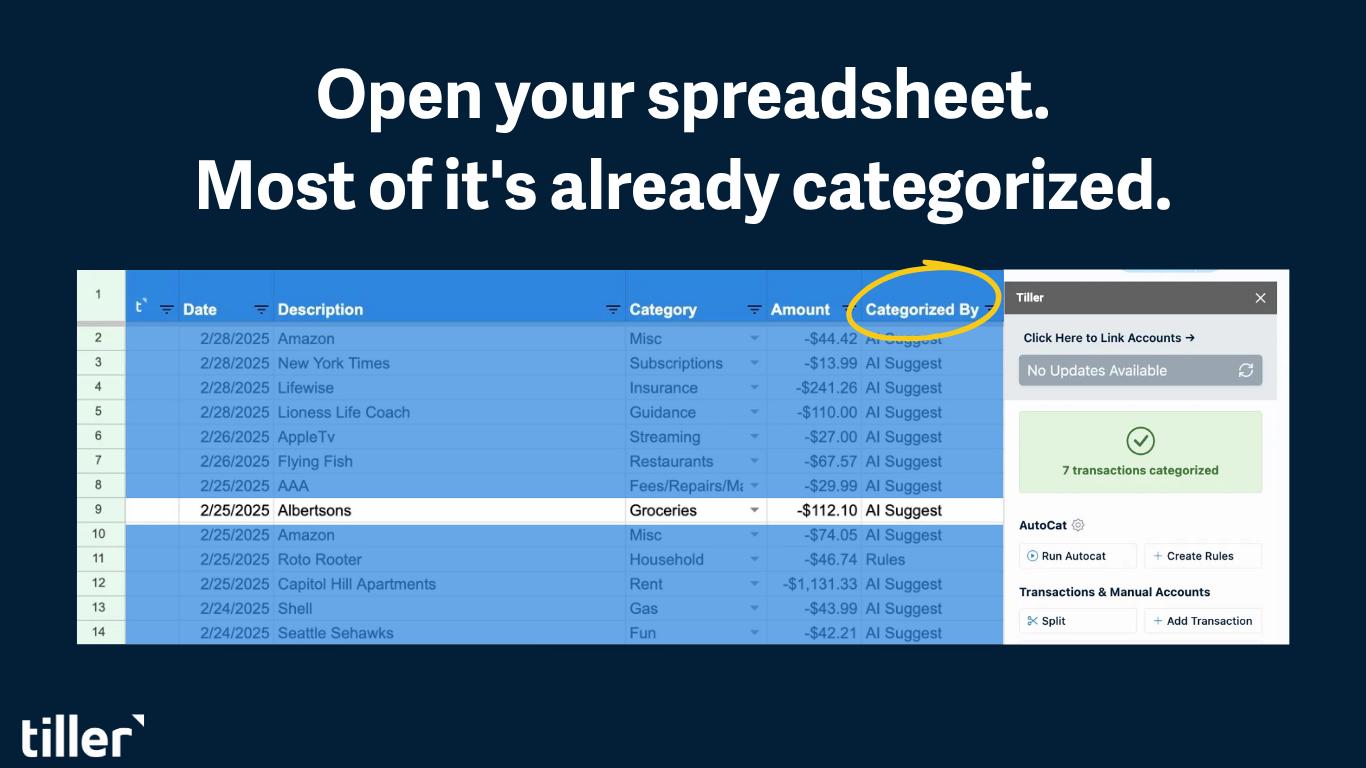
The reason it helped me get past the avoidance wasn’t that it gave me more discipline. It was what made the looking part frictionless. My bank and credit card transactions just show up in a Google Sheet or Excel workbook every day. I don’t log into anything. I don’t export anything. The numbers are already there when I’m ready to look at them.
That sounds small, but it removed the biggest excuse I had: the activation energy required to open six banking websites and reconstruct my week. When the numbers are already in one place, looking takes ten minutes. And ten minutes is short enough that I can’t really negotiate my way out of it. If you want to try it, you can do that for free for 30 days. After that, it’s $99/year, which is about $8.25/month. You can include it in your budget. Pretty cool.
One more thing
If you only take one sentence from this, take this one: the numbers get easier every time you look.
The first time is the hardest. The second time is less hard. By the tenth time, you’re just doing something you do, like checking the weather. You stopped being afraid because you stopped not knowing.
You can hold my hand while you do the first one. I’ve been there. We’ll get through it — together.