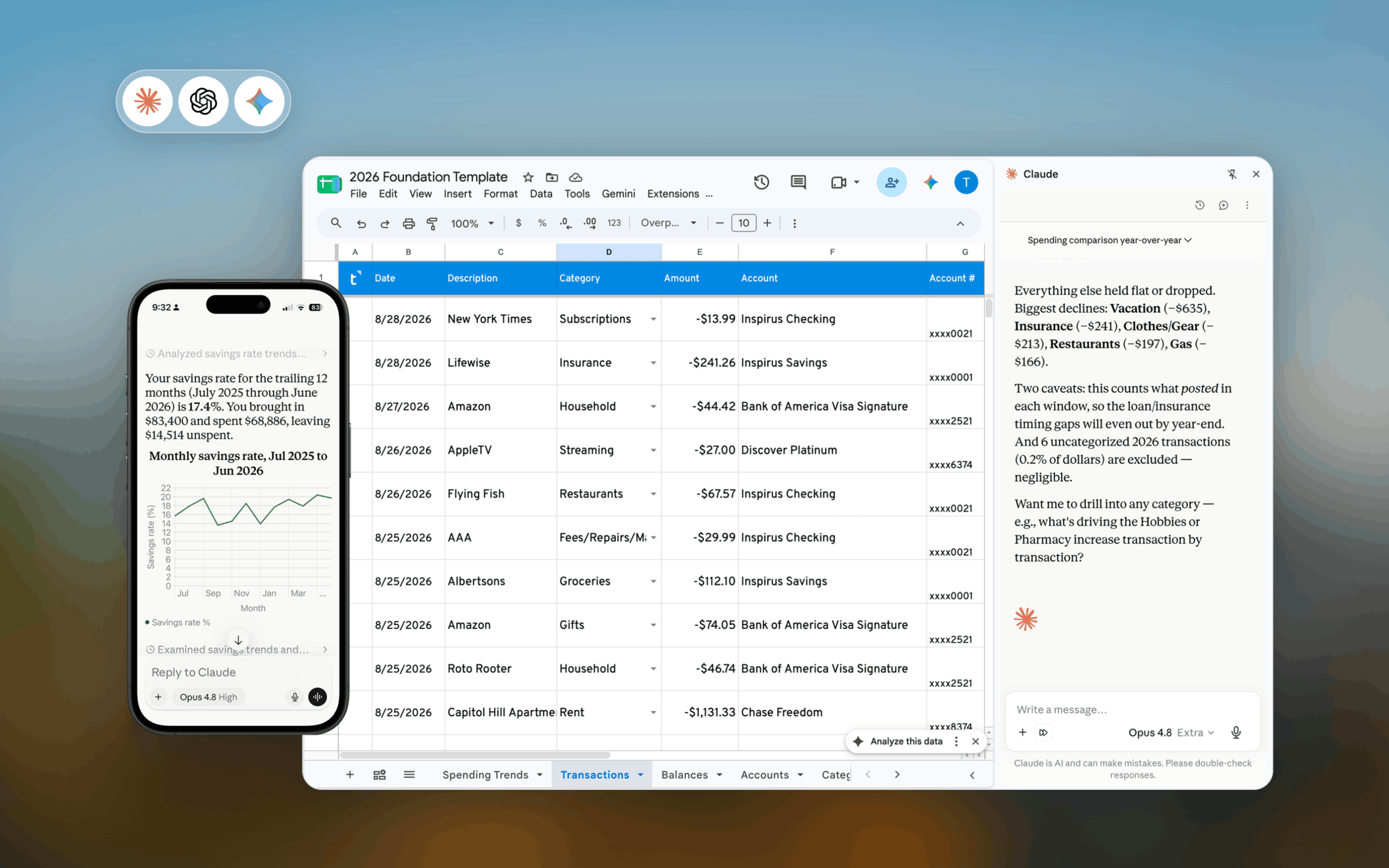
ChatGPT Pro users can now connect their bank accounts. Perplexity launched something similar in April. Claude gained financial connections through the Era MCP in early May. Gemini and Copilot will follow.
This is the new category, not a one-off announcement. Personal finance is getting an AI front end, and the race to build it is on.
We think that’s good for those who choose to share their financial data with AI. Most people don’t have a financial advisor. And there’s value in AI that can answer “why did I spend more this month?” from your actual transactions, instead of generic budgeting advice, or telling you whether you can afford the trip you’re already half-planning.
That’s the same job Tiller exists to do. When your money feels unclear or out of control, you need a way to see it and act on it. More tools helping more people do that is a good thing for everyone.
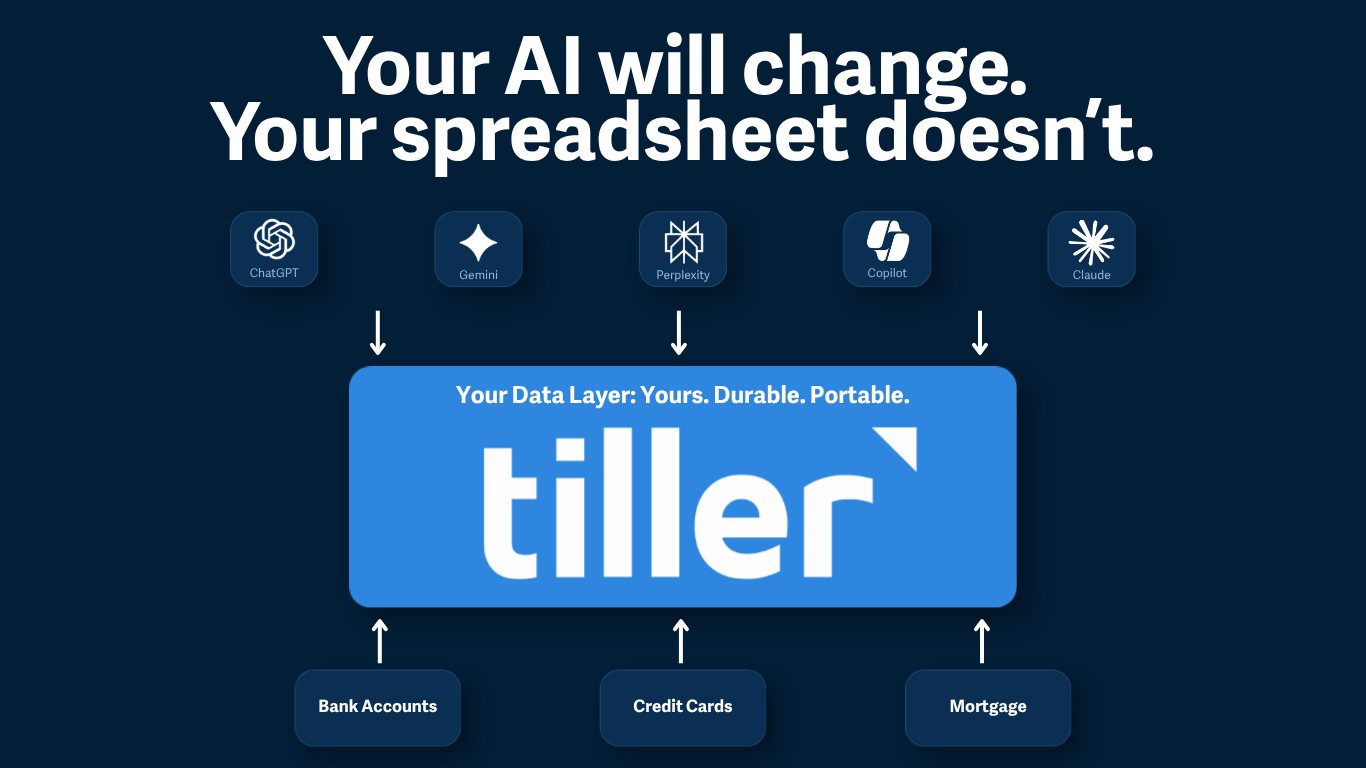
Tiller is the layer underneath the AI.
AI front ends will change. Models will improve, get replaced, lose investors, and win investors. Subscriptions will get cheaper. Subscriptions will get more expensive. New features will ship every quarter. Some of them will be great. Some won’t last.
What should last is the data itself and the layer that owns it. That layer should be yours.
Your transactions. Your balances. Your categories. The decade of personal financial history that, viewed together, is the most honest record of your actual life. That data deserves to live somewhere durable, somewhere portable, and somewhere you control. Not somewhere you rent month to month from whichever AI company is winning at the moment.
That’s what Tiller is. Has been since Day 1. Now for more than a decade.
1. Your data is yours. Not rented. Not licensed. Yours.
A $200-a-month AI subscription is, in practice, a rental of access to your own financial picture. Cancel it, and the dashboard disappears. The “you’re 14% over budget on groceries this quarter” disappears. The chart of your savings rate over the last eighteen months disappears. The AI moves on; the only thing left is whatever you remembered to write down.
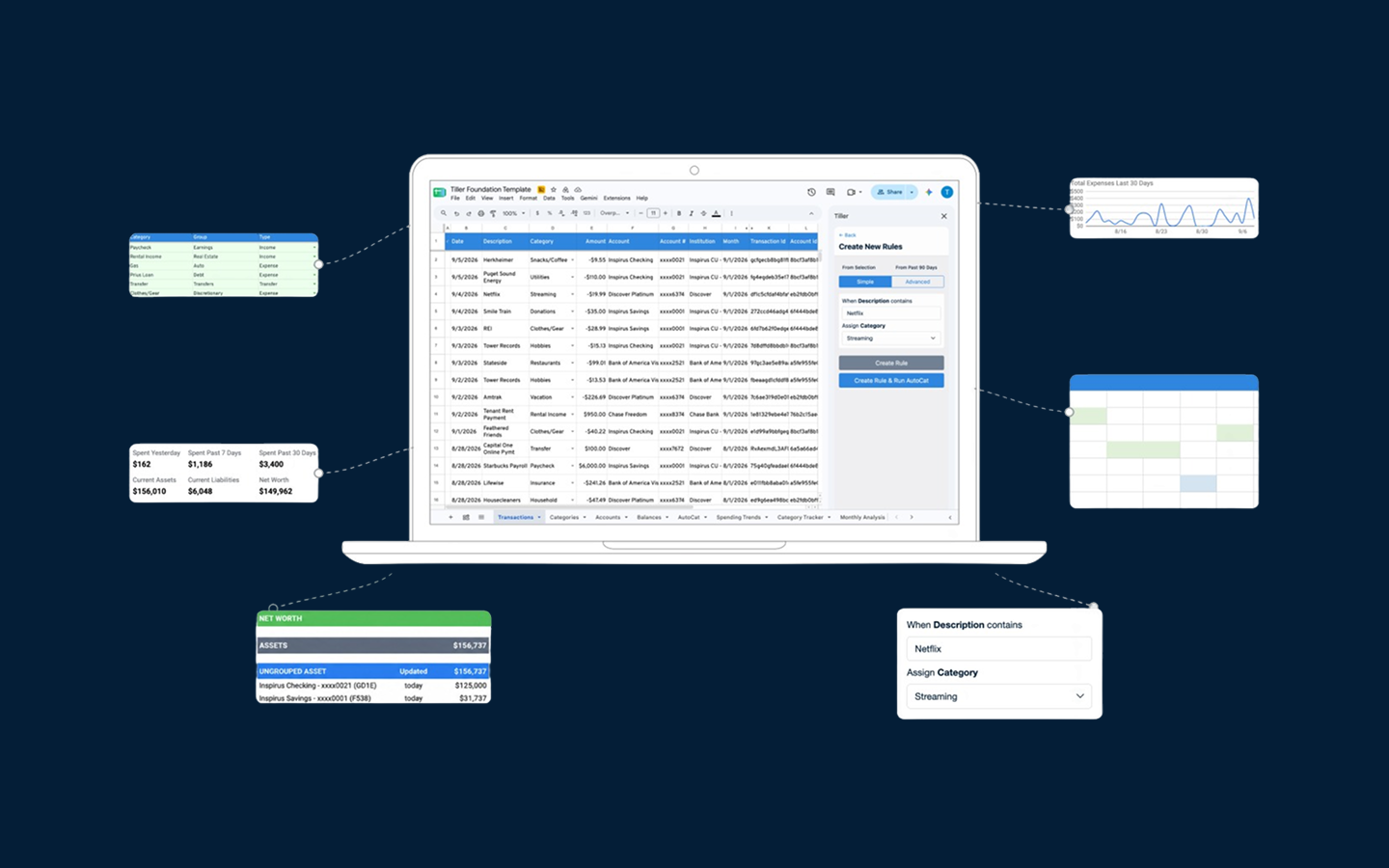
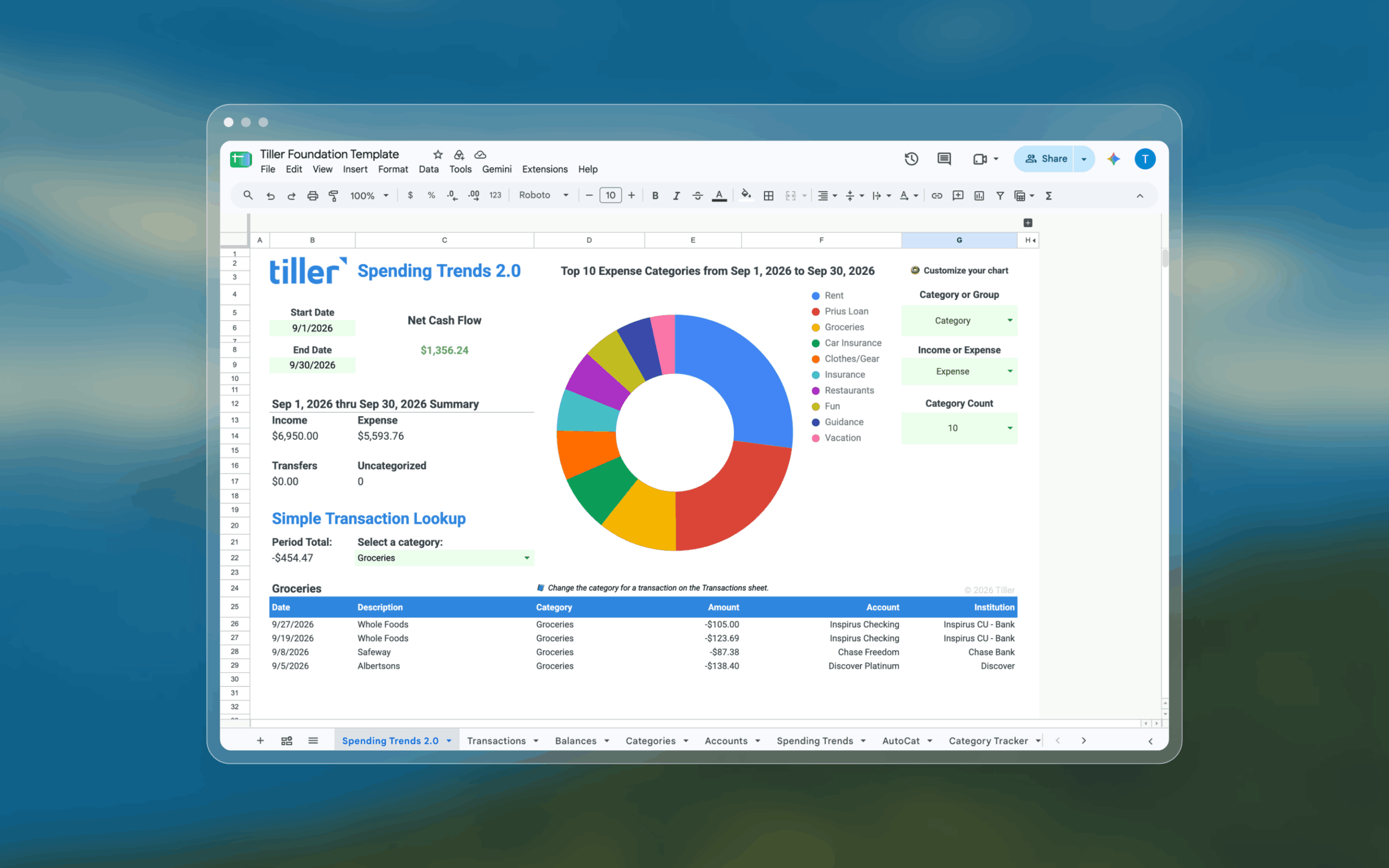
Tiller is built for longevity and data ownership. Your bank transactions flow directly into a Google Sheet or Excel file you own, sitting in your Google Drive or OneDrive. Close out the year, it’s still there. Need it in ten years, it’s still there. Switch AI tools next month, switch accountants next year, switch banks the year after that? Your data comes with you.
A few things to know about how that works:
- Your individual transactions and balances are invisible to our team. No one at Tiller can see them. That’s not a policy, it’s how the product is built. It’s point #6 in our 12-point Security Promise, and it’s an architectural decision defining how we built Tiller.
- You don’t have to migrate anything to leave. If you cancel Tiller, every transaction, category, and template stays in the spreadsheet you own in your account. Already exported. Already yours. More on that here.
2. You choose what the AI sees.
Many people are not comfortable with the “connect your accounts to one AI” model all-or-nothing approach. You either hand over the full financial picture or you don’t get the help.
Tiller is different by design. Want your AI to help with monthly budgeting but not see your brokerage balance? That’s easy with Tiller, where you can put spending in one sheet and investments in another. Share the spending one. Done. You can show an AI your last quarter without showing it your last decade. You can give your accountant the full file and the AI a sanitized subset. The choice (every time, every connection) is yours.
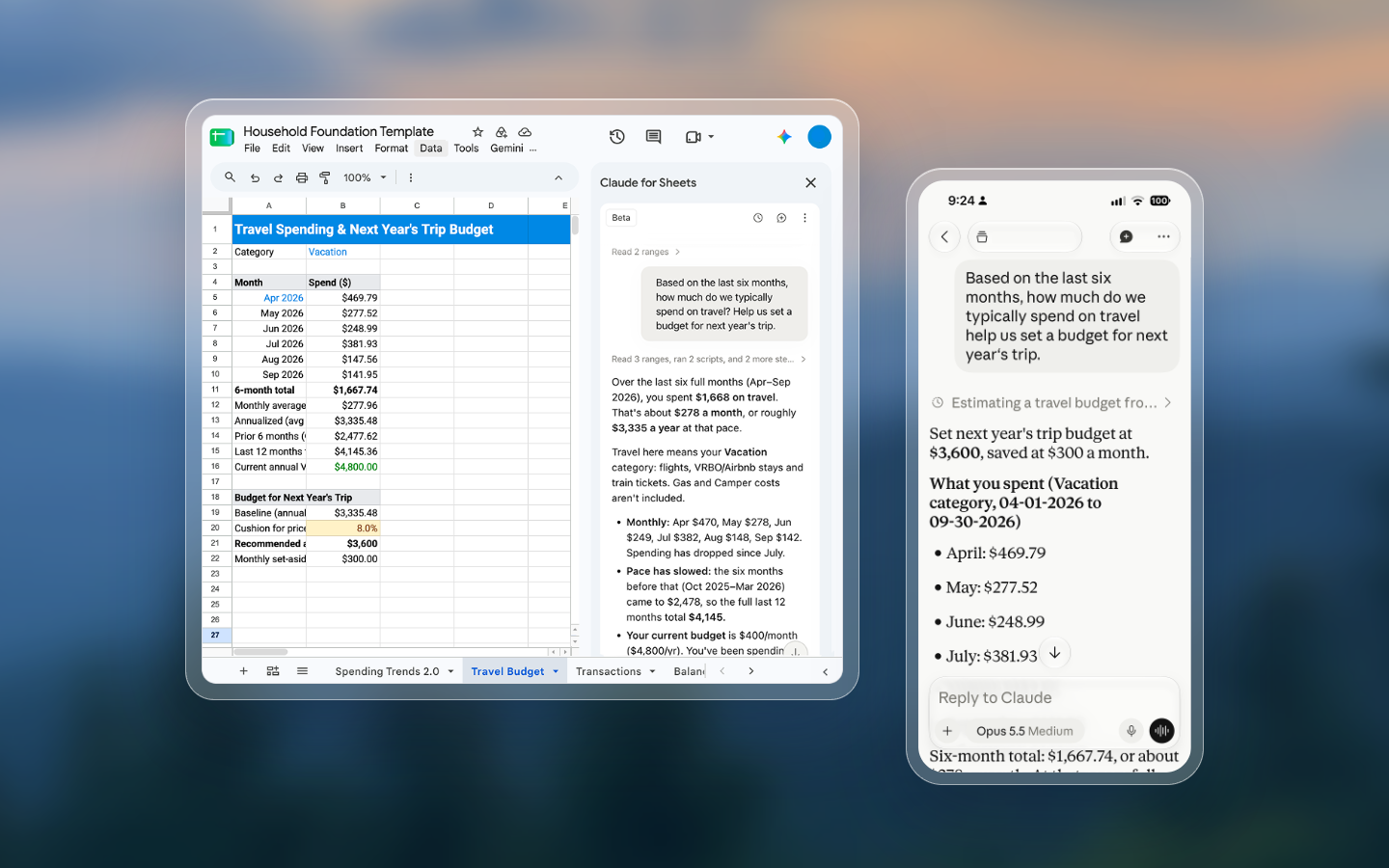
Customers who want AI with their Tiller spreadsheet can opt into CoPilot or Claude in Excel as well as Gemini in Sheets. Our MCP server (beta) supports optional integrations with Claude and, soon, ChatGPT.
For everything else — opening your Tiller spreadsheet and pasting it into your favorite AI, building your own automation, plugging in a tool we’ve never heard of — that’s your call to make. Your spreadsheet is yours. We don’t track what you do with it. That’s the whole point.
3. The format your financial life already speaks.
Your accountant works in spreadsheets. Your tax preparer works in spreadsheets. Your financial advisor’s models live in spreadsheets. When you need to dispute a transaction or document an expense, a spreadsheet is what you send. When tax season hits, no one wants a screenshot of an app dashboard. They want a spreadsheet they can sort, filter, and send.
Spreadsheets have been the universal language of financial data for forty years. Every AI tool worth using can read them. They’re not a Tiller-only thing. They’re the thing.
A proprietary dashboard ages with the company that built it. A spreadsheet ages with you.
4. We’ve got your back.
A decade running real-time bank data feeds at scale. Two aggregators (Plaid and Yodlee) instead of one, because connections break and redundancy matters when the connection is to your bank. World-class customer support. An active community of users sharing templates and helping each other get more out of their data. Microsoft built its own version first, then chose to partner with us instead.
The race to build a chat UI is loud and fast. The work of running a reliable, secure financial infrastructure for ten years is methodical and quiet. We’ve done the careful, quiet work.
5. Personal finance, priced for anyone.
ChatGPT Pro is $200 a month. Premium AI subscriptions across the board have landed at roughly the same price. For most people, that’s a work plan, paid for by an employer, attached to a work account. Change jobs, and you lose access to it. Your “personal” financial history was living inside something your company owned the whole time. Quit on a Friday, lose access on a Monday, including the AI’s record of every conversation you ever had about your money.
Tiller is $99 a year. Under $10 a month. Funded entirely by your subscription, not ads inside the product, not data sold to third parties. It’s yours, not your employer’s. And if you want to use AI on top of it, you can use the AI you already have, the one your work pays for, or no AI at all. The financial layer doesn’t depend on what you’re paying for the layer above it.
Your AI will change. Your spreadsheet doesn’t.
AI in personal finance is going to keep moving: new models, new interfaces, new features, every few months.
We’re not trying to be the best AI. We’re trying to be what the best AI is built on.
AI gets to be the smart part. The data underneath is yours.
Your AI will change. Your spreadsheet doesn’t. The job stays the same: clarity, control, and confidence about your money. We’re building the layer that delivers it.