How to Build a Complete Net Worth Tracking System in a Spreadsheet
Build a complete net worth tracking system in Google Sheets or Excel. Track assets, liabilities, and financial progress over time with monthly snapshots and trend charts.

Tiller Resource Center > Spreadsheet Financial Systems > Net Worth & Cash Flow Spreadsheets
Monthly budgets answer the question “Where did my money go?” Net worth tracking answers a more important question: “Am I actually getting ahead?”
You can follow a reasonable budget every month and still make no financial progress if money is quietly leaking into debt interest, lifestyle inflation, or unrealized losses. Net worth — total assets minus total liabilities — is the number that tells you whether your day-to-day budgeting is actually working.
Why net worth is the most important number in personal finance
Net worth = total assets − total liabilities. It’s the single number that captures your complete financial position at any moment in time.
Monthly budgets show you cash flow. Net worth shows you accumulation. The distinction matters: you could have a month where you stay perfectly within budget but your investment account drops $3,000. Your budget looks fine. Your net worth doesn’t. Tracking both gives you the full picture.
The other reason to track net worth over time is motivation. Small monthly gains — $200 here, $500 there — are easy to dismiss when you’re looking at any single month. But plotted on a chart over 12 or 24 months, those same gains become a visible upward trend. That visual is one of the most powerful things you can have in a personal finance system.
Net worth tracking also catches problems early. If your number is stagnating or declining for two or three months in a row, that’s a signal worth investigating — before it becomes a bigger issue.
What to include in your net worth calculation
Assets to include:
- Checking accounts
- Savings accounts and money market accounts
- Brokerage and investment accounts
- Retirement accounts (401k, IRA, Roth IRA)
- Real estate (current estimated market value)
- Vehicles (conservative current value)
- Any other significant assets
Liabilities to include:
- Mortgage balance
- Student loan balances
- Auto loan balances
- Credit card balances
- Personal loan balances
- Any other outstanding debts
What to leave out: Everyday personal property — furniture, clothing, electronics. These items are difficult to value consistently and don’t meaningfully affect your financial position. The goal is a consistent, honest snapshot, not an exhaustive inventory of everything you own.
A useful rule of thumb: if you wouldn’t list it on a loan application, you probably don’t need it in your net worth tracker.
Setting up your net worth spreadsheet
A functional net worth tracker needs just two sheets.
Sheet 1: Accounts
List every asset and liability account with its current balance. Group them by type:
- Liquid assets (checking, savings)
- Investments (brokerage, retirement)
- Property (real estate, vehicles)
- Debts (mortgage, auto, student, credit cards)
Add a formula at the bottom of each group to total each section:
=SUM(B2:B8)
Then calculate net worth:
=Total Assets – Total Liabilities.
Sheet 2: Monthly Snapshots
This is the heart of the system. One row per month, with these columns:
| Month | Total Assets | Total Liabilities | Net Worth | Change |
| Jan 2026 | $187,400 | $124,600 | $62,800 | — |
| Feb 2026 | $189,100 | $123,900 | $65,200 | +$2,400 |
| Mar 2026 | $191,500 | $123,200 | $68,300 | +$3,100 |
The Change column: =Current Net Worth – Previous Net Worth. This is where you see monthly progress at a glance.
The system can be genuinely simple. A functional net worth tracker can be two sheets and 20 rows. You don’t need to build something complex to get value.
How often to update (and what the routine looks like)
Monthly is the right cadence. More frequent than monthly creates noise — day-to-day market fluctuations and mid-cycle credit card balances make the number less meaningful. Less frequent than monthly loses the trend data that makes the system valuable.
Pick a consistent date — the first of the month or the last day of the month work well — and stick to it. The ritual matters as much as the system.
Monthly routine (10–15 minutes): Log in to each account (or check your Tiller balances if you’re using automated feeds), update the current balance for each account on your Accounts sheet, and let your Monthly Snapshot row calculate automatically from those totals. That’s it.
Quarterly review (10 minutes): Look at the past three months of snapshots. Is your net worth growing? Flat? Declining? Is any particular account moving in the wrong direction? This higher-level view catches trends that monthly snapshots can obscure.
Of the two, the monthly routine is the one that matters most. Ten minutes, once a month, consistently. And even if your estimates are approximate, consistent snapshots are more valuable than occasional precise ones.
Building a net worth trend chart
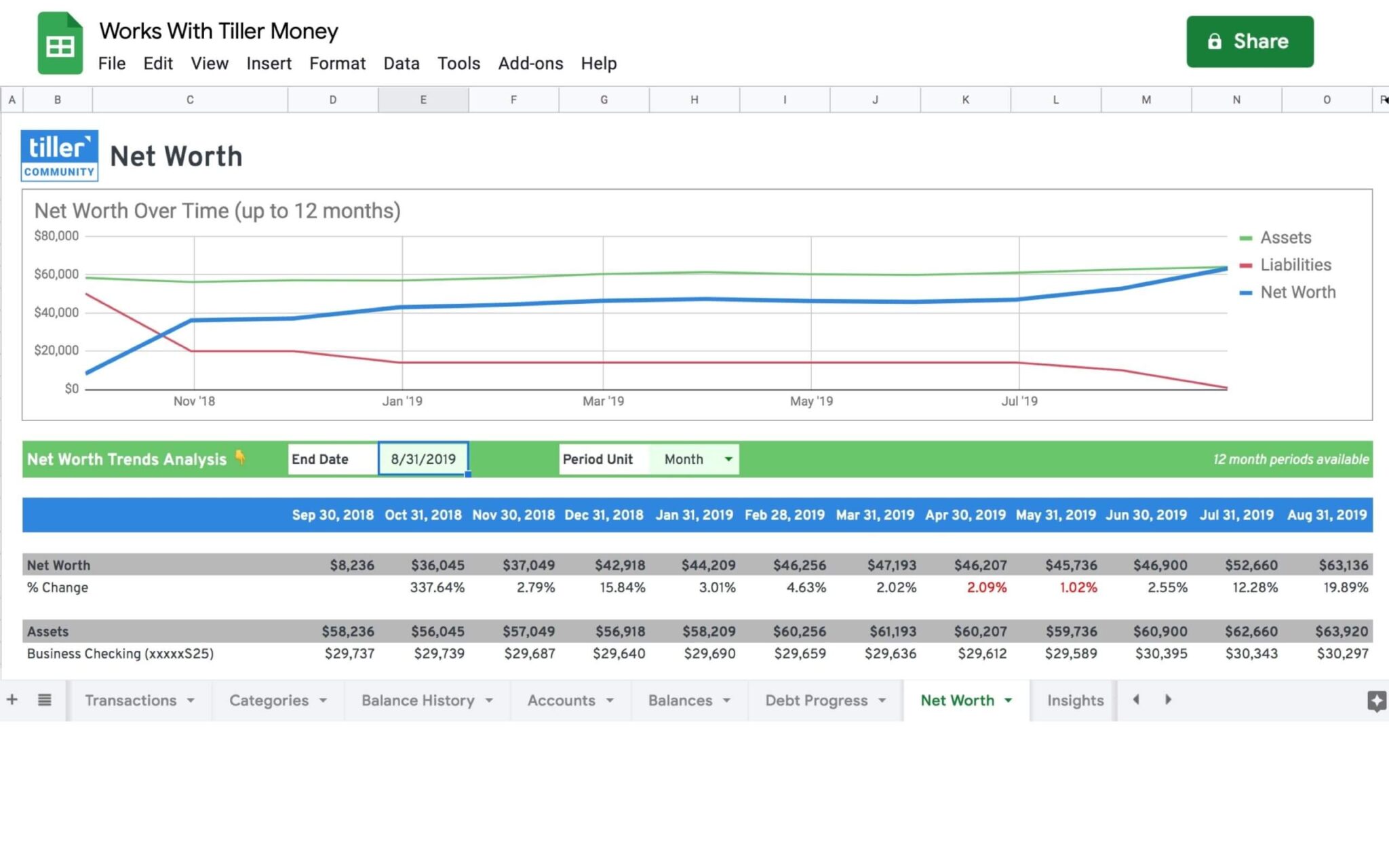
A line chart of net worth over time is for many people the single most motivating visualization in personal finance.
To create one in Google Sheets or Microsoft Excel: select your Month and Net Worth columns from the Monthly Snapshots sheet, go to Insert → Chart, and choose Line Chart. The app will build it automatically.
For an extra layer of insight, add a second data series for total debt. As debt declines and net worth rises, the two lines move in opposite directions — a visual often called the “scissors pattern.” Watching those lines diverge over 12 to 24 months makes the day-to-day work of budgeting feel real.
Once you have 6–12 months of data, the chart really starts to give you meaningful insights. You can see the effect of a debt payoff, a market downturn, or a savings push. The visual turns a number into a story.
Automating net worth tracking with Tiller
The main friction in net worth tracking is looking up balances. With five or more accounts across different institutions, logging in to each one, finding the current balance, and recording it manually can take 15–20 minutes every month. It’s not hard — but it’s enough friction that it’s easy to skip.
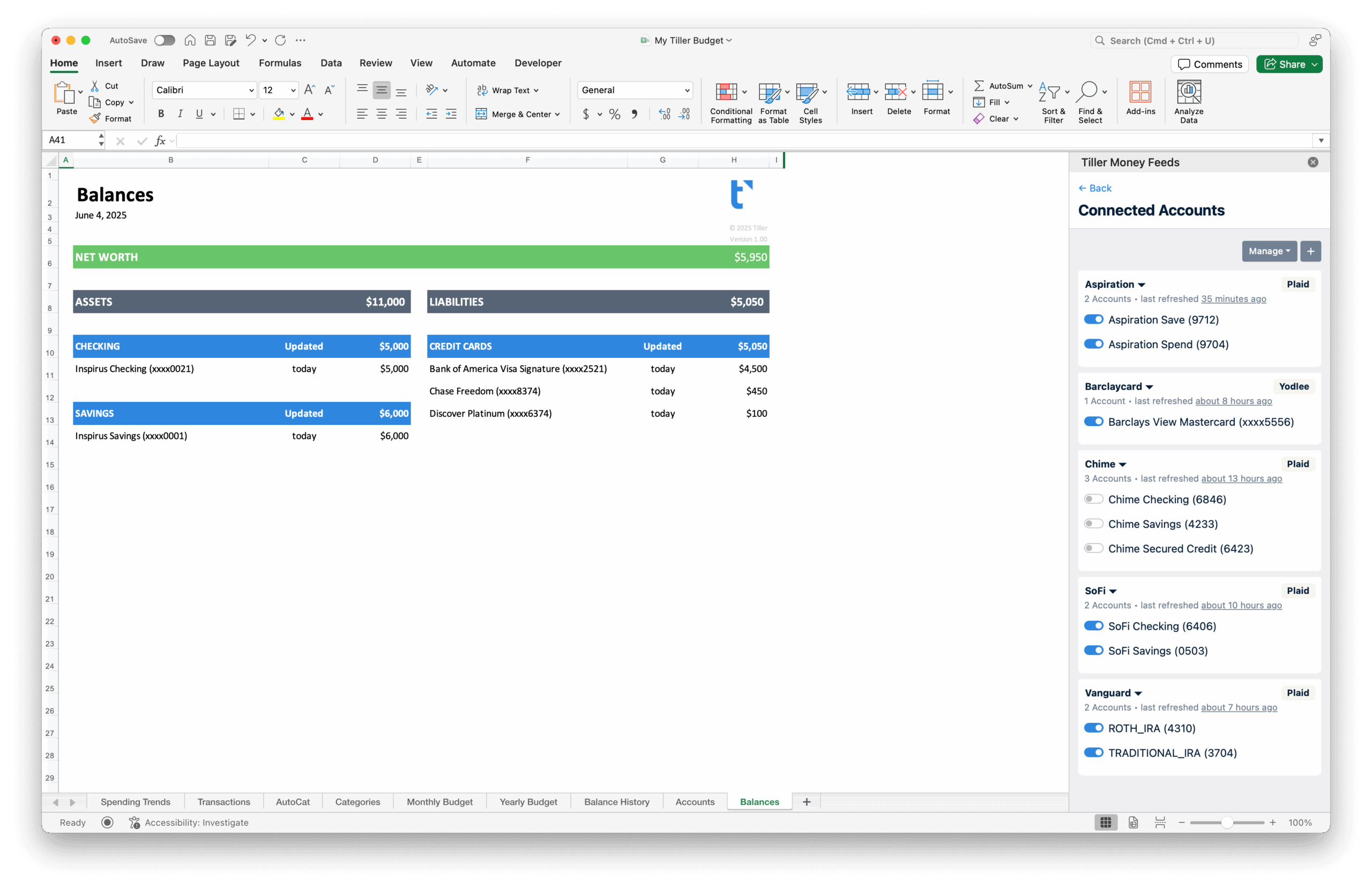
Tiller’s Balance History sheet captures daily balances for all connected accounts automatically. Your checking balance, savings balance, credit card balance, investment account value, and loan balance are all updated every day in your spreadsheet.
When your monthly net worth update day arrives, the numbers are already there. You’re not looking anything up — you’re reviewing data that’s been collecting itself. The monthly routine drops from 15 minutes of account-by-account lookups to 2–3 minutes of analyzing your data.
Frequently asked questions
What accounts should I include in a net worth spreadsheet?
First, assets, including checking accounts, savings accounts, money market accounts, brokerage and investment accounts, retirement accounts (401k, IRA, Roth IRA), and real estate equity. Second, liabilities, including mortgage balance, student loans, auto loans, credit card balances, personal loans, and any other outstanding debts. Leave out everyday personal property — the goal is a consistent, honest financial snapshot, not an exhaustive inventory.
How do I calculate net worth in Google Sheets or Microsoft Excel?
Net worth is total assets minus total liabilities. List all asset balances in one section, use =SUM() to total them. Do the same for liabilities. Create a net worth cell: =TotalAssets-TotalLiabilities. To track it over time, add one row per month to a snapshot sheet with columns for Month, Total Assets, Total Liabilities, Net Worth, and Change. The change column uses =CurrentNetWorth-PreviousNetWorth to show monthly progress automatically.
How often should I update my net worth spreadsheet?
Monthly is the right cadence for most people. More frequent creates noise from daily market fluctuations and mid-cycle credit card balances. Less frequent loses valuable trend data. Pick a consistent date — the 1st or last day of the month — and record a snapshot. With Tiller, account balances update daily automatically, so the numbers are already there when you sit down to record the monthly snapshot.
What’s the most motivating thing about tracking net worth in a spreadsheet?
The trend chart. Once you have 6–12 months of monthly snapshots, a line chart shows your financial trajectory over time. Seeing the line move upward — even modestly — month after month is more motivating than any individual budget category. Many people find the net worth chart is what keeps them engaged with their financial system long-term, because it makes the day-to-day work visibly meaningful.